Durant le mois de Juillet cours seulement le lundi 17h30-19h, mardi 18h-20h, le jeudi 17h30-19h Mois d'août, pas cours.
The themes

What we
actually work on.

A class is never a string of isolated movements. Behind every motion live principles — relaxation, centre line, economy — and tools — Chi Sao, wooden dummy, self-defence. Here is the full map of the concepts that shape Wing Chun practice.

The first principle

Relaxation

放鬆 · fong sūng

Before speed, before power, before technique: relaxation. It's the first thing you learn, and the last thing you ever stop working on.

The natural reflex when facing a threat is to tense up. Wing Chun does the exact opposite: it teaches you to engage only the muscles strictly needed for the movement, and to neutralise their opposites. A tensed arm fights itself — half its strength goes into holding back the other half.

A relaxed limb is faster, because nothing holds it back; and more powerful, because all the energy goes toward the target instead of dissipating into useless tension. Strength doesn't come from a tensed muscle but from the body's structure, transmitted from the ground to the point of contact.

Relaxation is also mental. A tense mind anticipates poorly, reads the opponent poorly, decides too late. So one cultivates an active calm — available, mobile, ready to respond without ever freezing up.

  • Economy Engage only the useful muscle, relax the rest.
  • Speed Nothing holds the movement back: it fires instantly.
  • Transmission Strength comes from the ground and the structure, not tension.

A bamboo bent by wind and rain stays intact, while a rigid branch has snapped — the image of relaxation.
Posture & footing

The body in space

馬步 · structure & déplacement

Holding your axis, distributing your weight, choosing your distance. Good footwork beats a good block: the best way to avoid a strike is to no longer be there.

Everything starts with the stance. Knees slightly bent, pelvis tucked, weight centred: a base from which you can strike, absorb and move without ever losing balance. This structure isn't rigid, it's alive; it absorbs and returns.

Footwork happens in small, precise steps, along triangles and pivots, always keeping the axis. You don't retreat by fleeing: you reposition to regain the angle. Every step has a reason — cutting the line, going around, closing the distance.

Mastering the body in space means learning to manage fighting distance: knowing when you're in range, when you're not, and how to cross that threshold at the right moment.

  • The axis The pelvis and spine hold the vertical, always.
  • The base Centred weight: you can strike without losing balance.
  • The distance Reposition rather than block — not being where the strike lands.
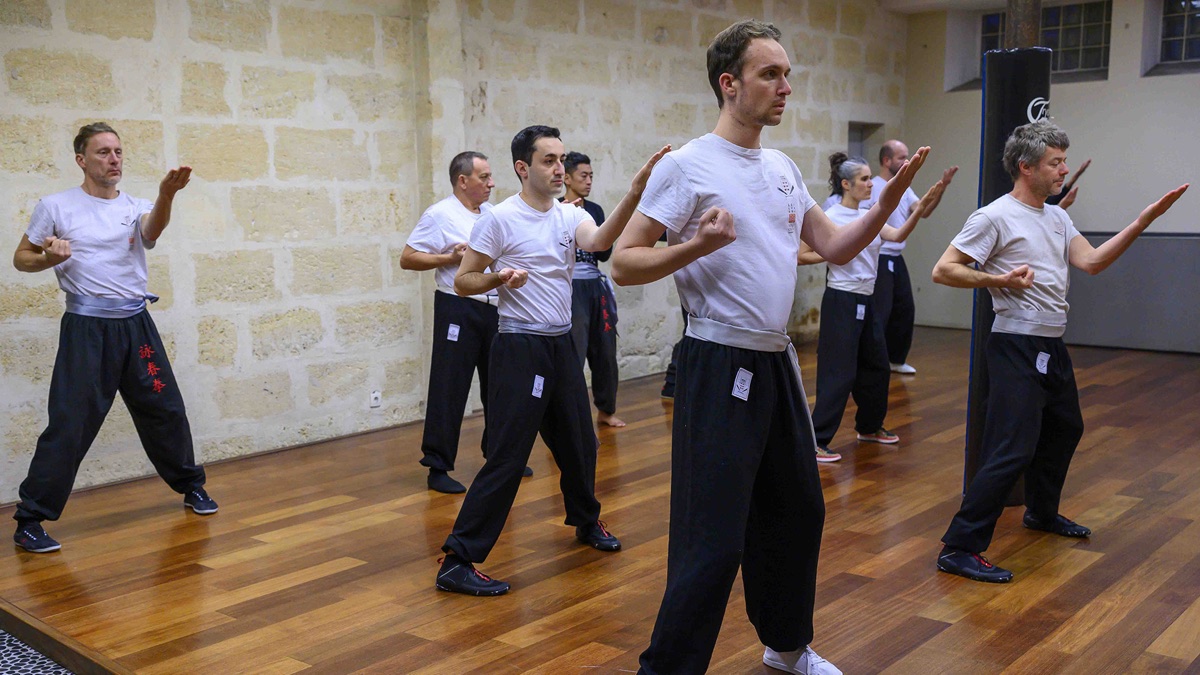
A group of practitioners hold the horse stance, arms raised, axis and footing aligned.
The guiding concept

The centre line

中線 · jūng sin

The straight line is the shortest path between two points. The centre line — the vertical axis connecting two opponents — is the territory the whole art seeks to occupy.

The centre line runs through the body from top to bottom and concentrates the vital targets. Whoever controls it attacks by the shortest path and defends by the most economical one. To lose it is to expose yourself; to reclaim it is to dominate.

Almost all the technique flows from this principle: strikes leave from the centre and return to it, defences deflect without ever abandoning the axis. You don't block wide, you don't go around needlessly — you occupy the middle and stay there.

It's an idea both geometric and strategic: holding the centre means holding the initiative. An opponent who wants to strike must first move your line — and every attempt opens a gap you already occupy.

  • The shortest path Attack and defend by the most direct route.
  • The targets The axis concentrates the vital points to protect and aim at.
  • The initiative Holding the centre keeps the advantage in every exchange.
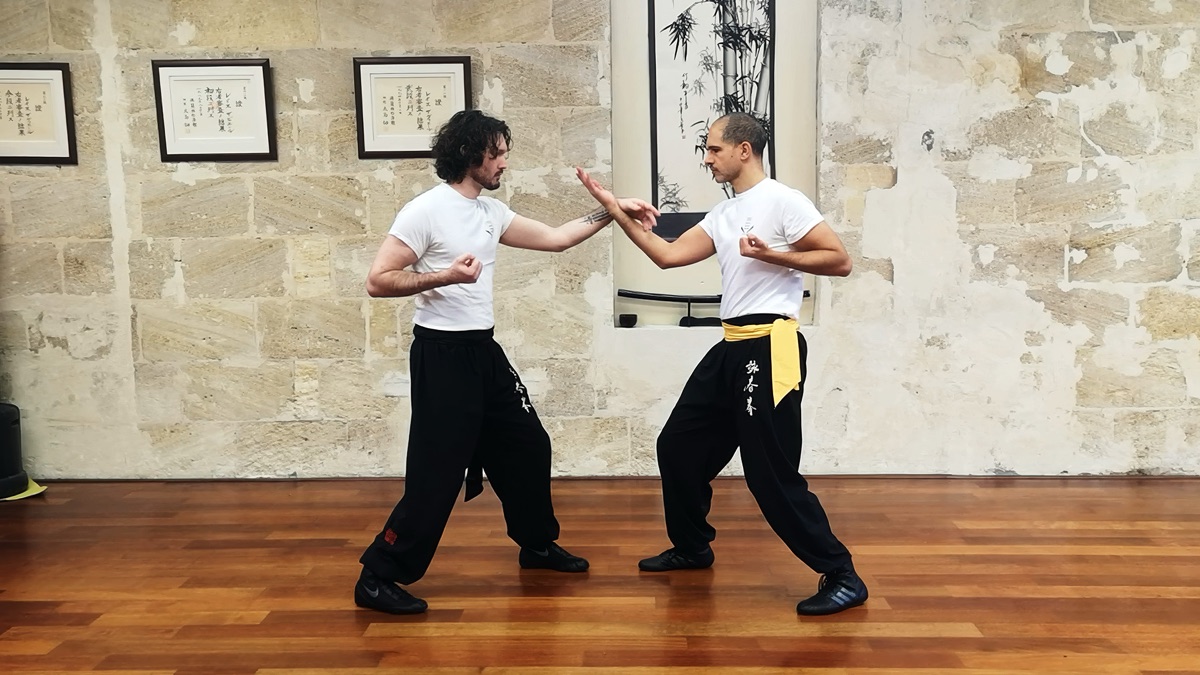
Two practitioners aligned on the centre line, arms extended meeting at the point of contact.
The right movement

Economy of movement

同時 · attaque & défense

Why make two movements where one will do? Wing Chun seeks simultaneity: defending and striking at the same time, never losing a fraction of a second.

Where many arts block then counter, Wing Chun seeks to do both at once: one hand deflects the attack while the other — or the same one — is already striking. The time saved is decisive; in a real exchange, it makes all the difference.

This economy shows up everywhere: no decorative movement, no wide wind-up, no wasted return. Every movement is short, direct, and carries its own threat. Less movement means fewer openings offered to the opponent.

Economy isn't laziness: it's efficiency pushed to the extreme. You strip the movement of everything that doesn't serve, until only the essential remains — fast, safe, impossible to anticipate.

  • Simultaneous Deflect and strike at the same time.
  • Direct No wind-up, no decorative movement.
  • Covered Less movement, fewer openings offered.
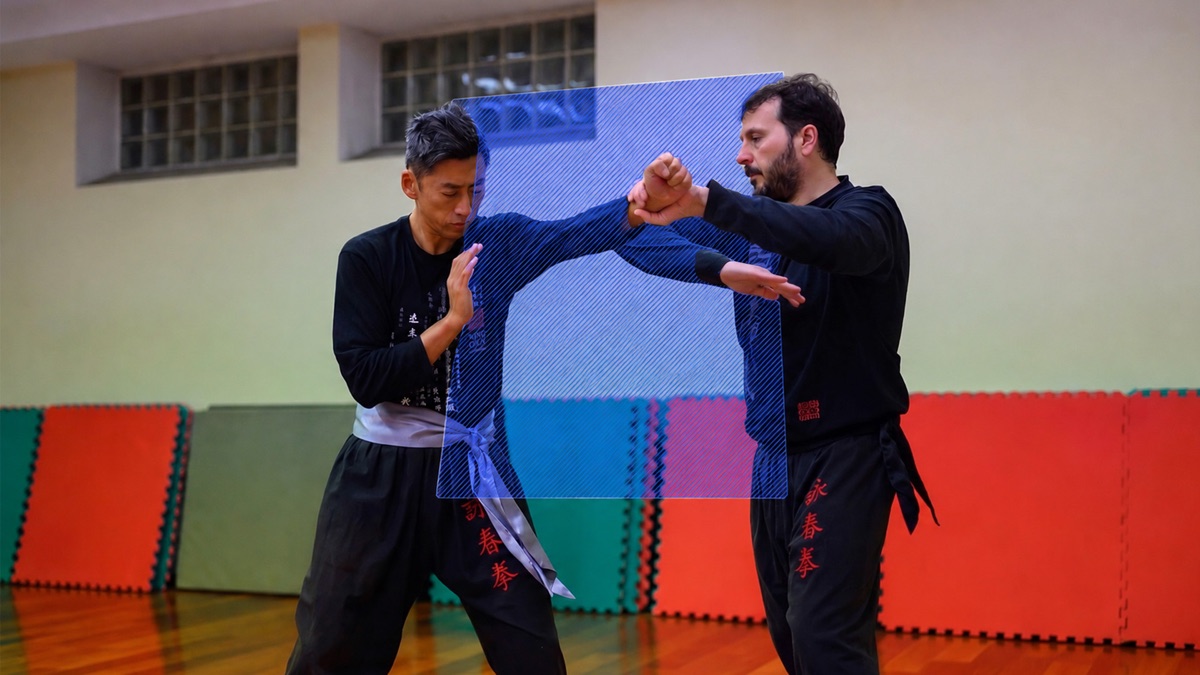
Two practitioners in close guard, one movement blocking and striking at the same time.
The sensitive core

Chi Sao

黐手 · les mains collantes

Forearms touch, contact circulates. Eyes open or closed, you learn to read the other's intention through contact alone — and to respond before it even shows.

Chi Sao, "sticking hands," is Wing Chun's signature exercise. Two practitioners keep their forearms in contact and cycle through a sequence of attacks and defences. It isn't a fight: it's a laboratory of sensitivity.

Through practice, tīng jìn develops — listening through touch. The skin and muscles perceive pressure, direction, the opponent's intention faster than the eye can see them. You stop thinking: the arm responds on its own, by reflex, to what it feels.

Chi Sao is the bridge between the form — learned alone, slowly — and real combat. This is where principles become reflexes: centre line, relaxation, simultaneity, all tested together, under progressive and controlled pressure.

  • Tīng jìn Listening to the opponent through contact, not sight.
  • The reflex Responding without thinking — the arm decides on its own.
  • The bridge From solitary form work to real application.
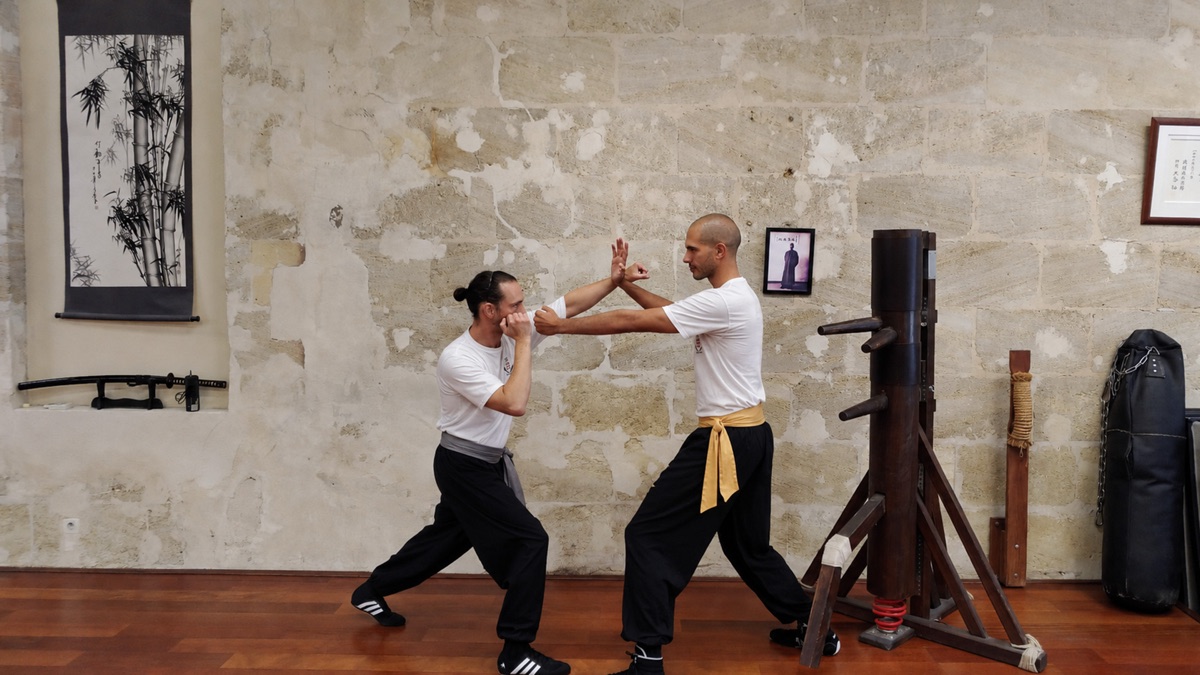
Two practitioners in Chi Sao, forearms in contact, keeping sensitivity and the centre line.
The wooden partner

The wooden dummy

木人樁 · Mook Jong

Three arms, one leg, an unmoving trunk: the wooden dummy is the partner that never tires and never lies. The form practised on it engraves the angles into the body.

The Mook Jong is a wooden trunk fitted with three arms and one leg, arranged to represent an opponent's structure. A codified form is performed on it — a long sequence of techniques — that synthesises the whole system.

Its value isn't strength: you don't strike the wood to toughen up, but to calibrate your angles, distances and structure. The dummy returns any positioning error without mercy; an imprecise movement hits the wood, a correct one glides through and finds its target.

It's also a memory: the dummy form is a repertoire of responses, a dictionary of movements you review alone, endlessly, until every angle becomes obvious to the body.

  • The angles Calibrating position, distance and structure against a fixed reference.
  • Rigour The wood doesn't forgive imprecision.
  • The repertoire A dictionary-form you review alone, endlessly.
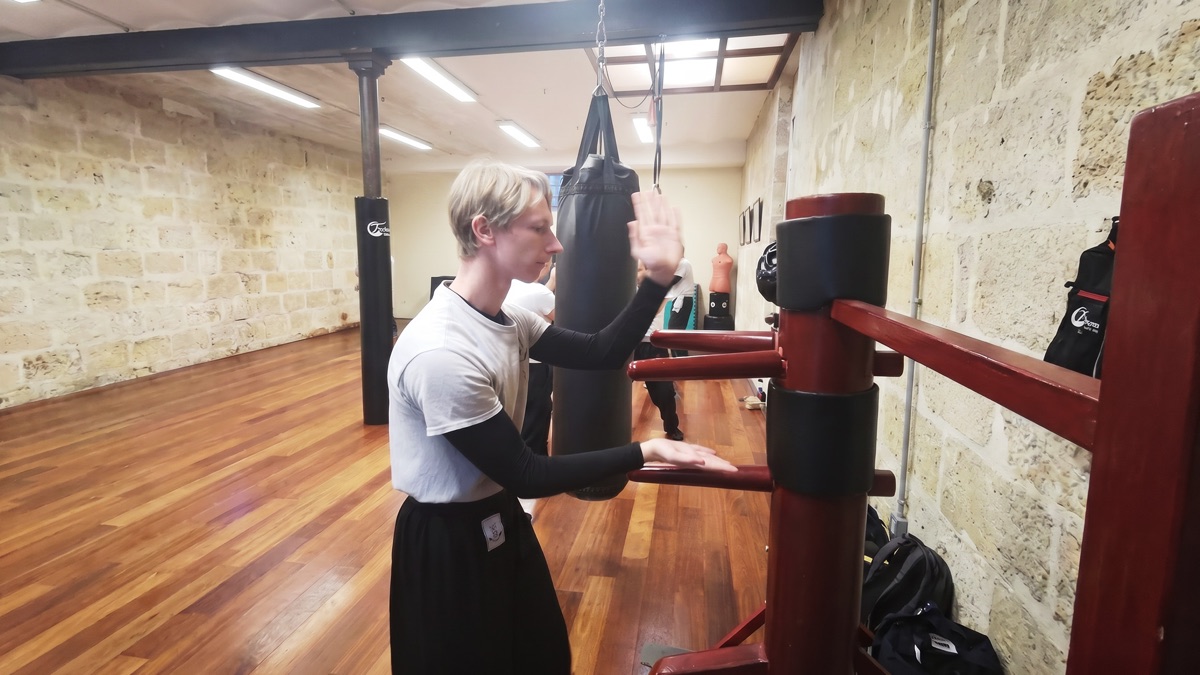
A practitioner working on the wooden dummy, arms resting on the branches.
Real application

Self-defence

擒拿 · self-défense & chin na

Grabs, assaults, situations you didn't choose: Wing Chun never forgets its purpose. It builds reflexes applicable under pressure, with no time to think.

Beyond the forms and Chi Sao, the work regularly comes back down to reality: what do you do against a wrist grab, a collar grab, a frontal assault? The principles — relaxation, line, angle — find their most concrete expression there.

Chin Na, the art of grabs and joint locks, completes the arsenal. Rather than opposing force, you control the joint, turn the attacker's own movement against them, unbalance them. Technique replaces raw power.

The goal is automaticity. A real assault leaves no time to choose: the response must already be wired in through repetition. That's why what will one day need to surge in a fraction of a second is trained slowly and at length.

  • The real Responses to concrete grabs and assaults.
  • Chin Na Controlling the joint rather than opposing force.
  • Automaticity A reflex wired in through repetition, ready under pressure.
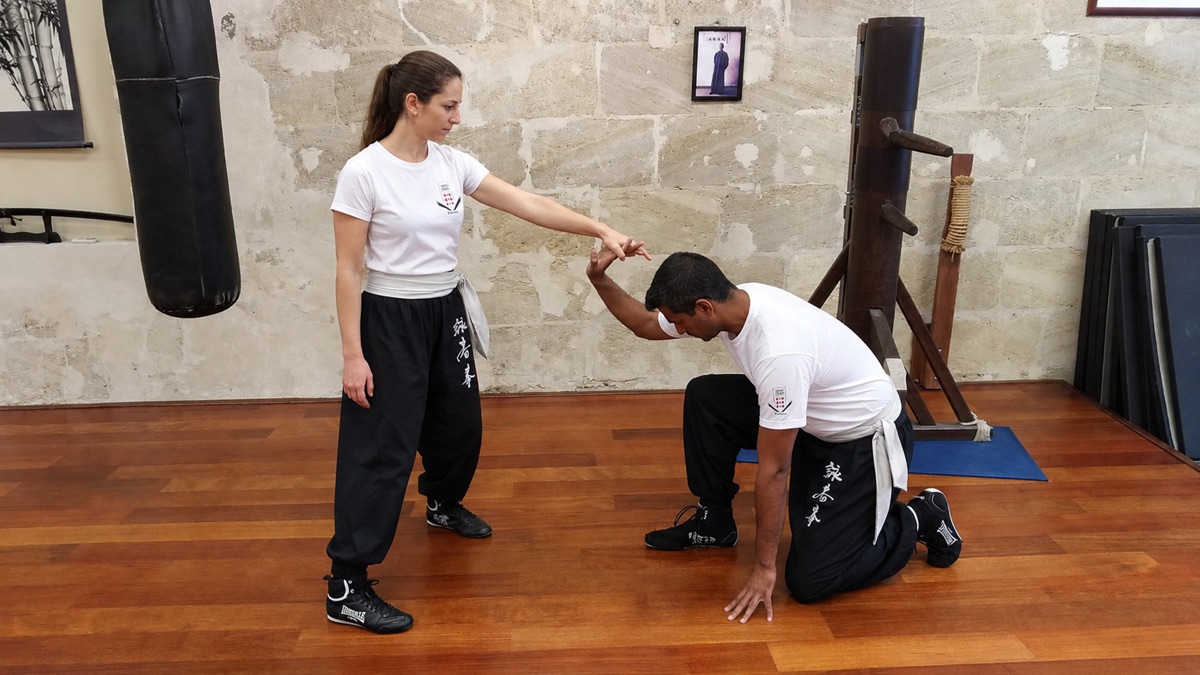
A joint lock applied in self-defence practice, a practitioner brought to the ground.
The Northern heritage

Kicks

腿法 · shaolin du nord

Inherited from Northern Shaolin, Wing Chun's kicks stay low, precise and structured. No gratuitous acrobatics: balance, line, and useful power.

In traditional Wing Chun, kicks rarely rise above the waist. They mainly target low areas — shins, knees, thighs, hips — where the attack is harder to see coming, harder to block, and where the kicker keeps their balance fully intact.

The principle stays the same as for the hands: structure, line, economy. The kick starts from the ground, travels through a solid supporting leg and delivers its force in a short, clean, direct movement. Balance is never sacrificed for reach.

In our lineage, Sifu Didier Beddar enriched this work through his martial background, notably his expertise in Northern Shaolin, a discipline renowned for the richness and power of its leg techniques. He thus introduced a more complete approach to the kick, not as a spectacular gesture, but as a formidable weapon once mastered.

These kicks blend naturally with hand work: you can strike with the foot while controlling the opponent's arms, adding a layer to the attack without ever giving up your guard.

  • Low & precise Shins, knees, hips — invisible and unblockable.
  • Balance Never sacrificed for reach or show.
  • Combined Kicking while controlling the opponent's hands.
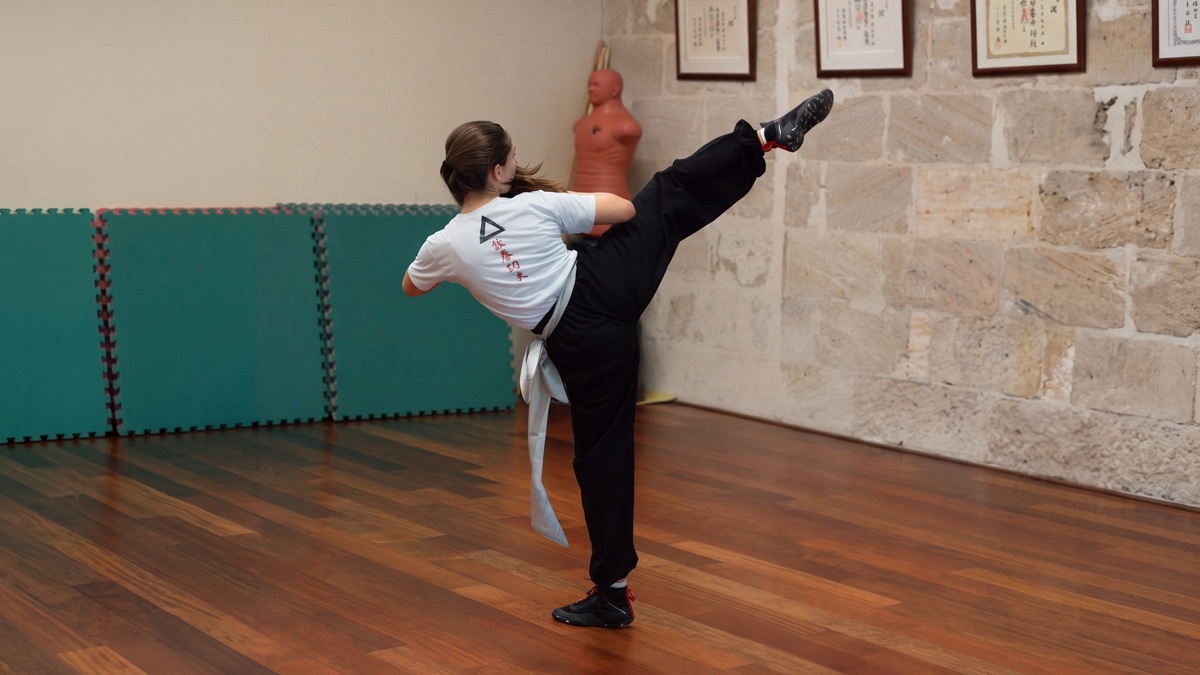
A practitioner performs a high kick against the wooden dummy.
Thinking the fight

Fighting strategy

戰略 · jin lüe

Wing Chun doesn't oppose force with force. It seeks the angle, the opening, the moment — it thinks the fight rather than enduring it, and makes intelligence a weapon.

Against a stronger opponent, a head-on clash is already lost. Wing Chun's strategy is to not be where the force lands: positioning on an angle, occupying the weak side, turning the opponent's power into an imbalance.

Economy is sought at the scale of the whole fight: entering at the right moment, closing the distance in one go, chaining without giving respite, exploiting every opening as it appears. Tempo and positioning matter as much as technique.

It's a way of thinking as much as a practice. You learn to read the other's posture, to anticipate their intention, to choose the movement that resolves the situation — not the most impressive one. Calm and clarity are, here, the first weapons.

  • The angle Positioning outside the opponent's line of force.
  • The tempo Entering at the right moment, closing the distance, not letting go.
  • Clarity Reading intention, choosing the movement that resolves — not the flashiest.
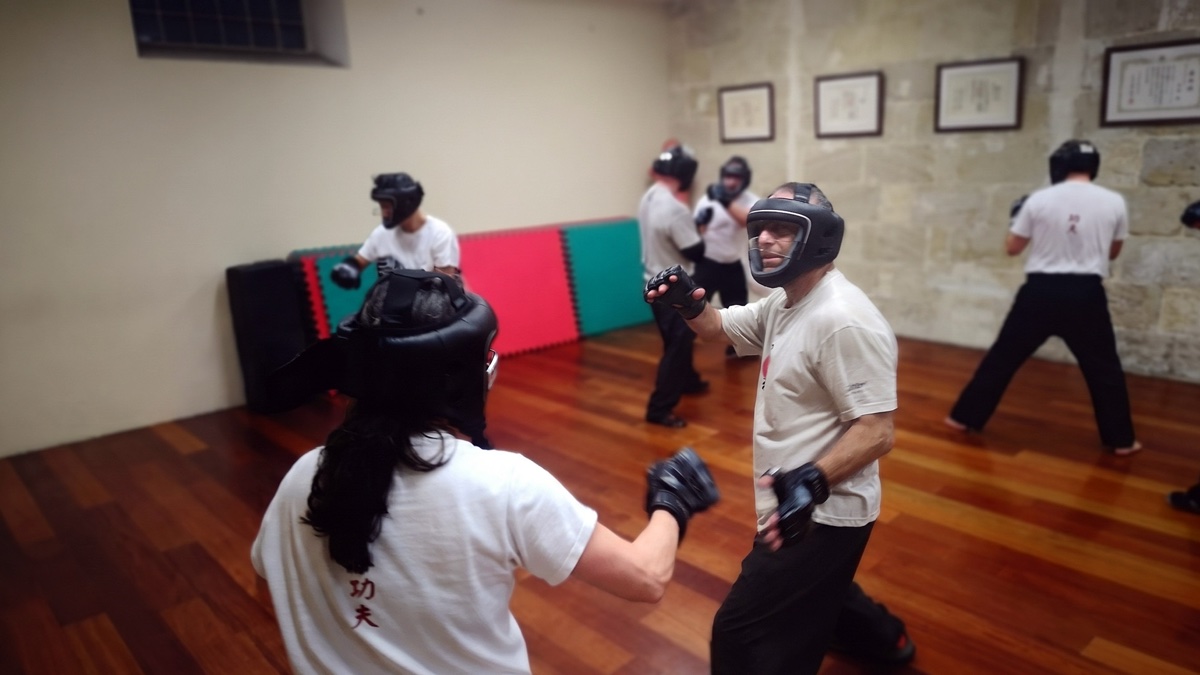
Two Wing Chun practitioners in a fighting situation, seeking the angle and the opening.
Beyond technique

The philosophy of Wing Chun

武道 · la voie martiale

Simplicity, straight lines, adaptation: the principles of the floor are also principles for life. Wing Chun is practised with the body, but understood with the mind.

Every traditional martial art is a path — a dào. Wing Chun is no exception: behind technical efficiency lies a way of being. The pursuit of simplicity, the rejection of the superfluous, economy of means matter well beyond combat.

The practitioner learns to stay calm under pressure, not to oppose one rigidity with another, to adapt to what comes rather than imposing a rigid plan. These qualities — flexibility, clarity, patience — are cultivated on the floor and spill into life.

It is also a transmission. Wing Chun is passed down from master to student, movement after movement, in keeping with a lineage and a living tradition. To practise is to enter this history and carry it forward in turn.

  • Simplicity Stripping away the superfluous down to the essential — on the floor and elsewhere.
  • Adaptation Aligning with what comes rather than imposing a plan.
  • Transmission A living art passed from master to student, movement by movement.
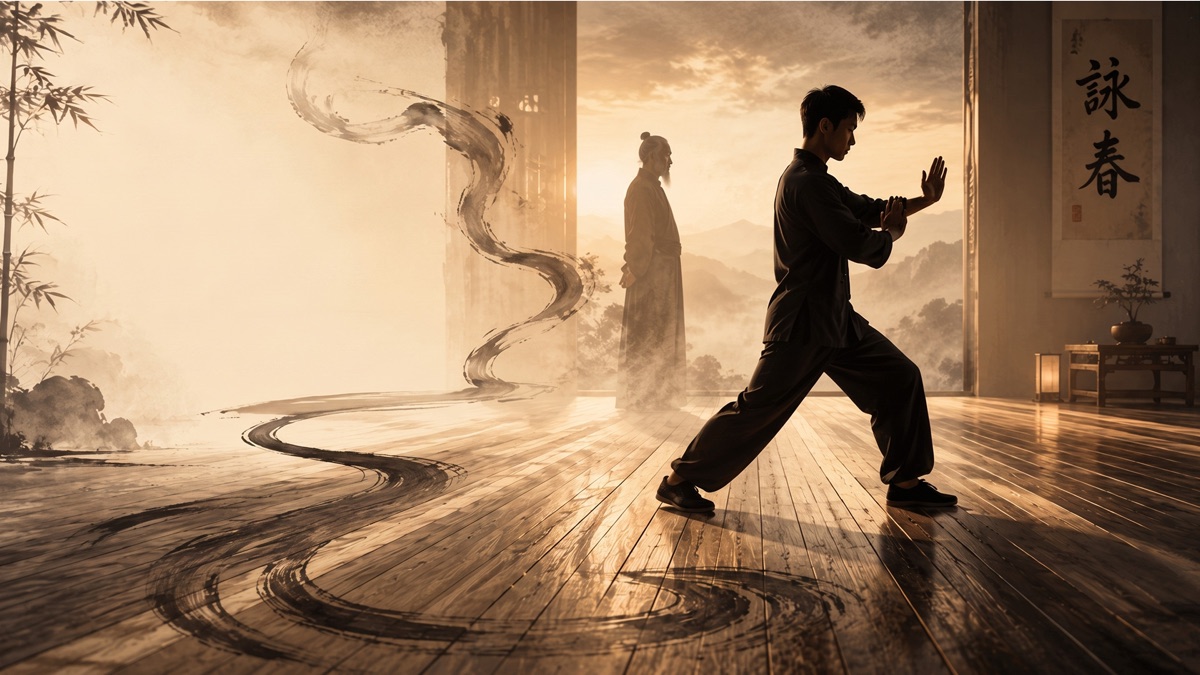
A practitioner in guard, a silhouette facing a master, in a kwoon steeped in calligraphy and mist.
From theory to the floor · 入門

All these principles
are lived, not read.

Every concept on this page takes on meaning from the first class — as a movement, a contact, a step. The first group class is free, no commitment.

See how a class unfolds