Wing Chun, a boxing art from the south
Born of a fleeing nun and a young woman who refused a forced marriage, Wing Chun has crossed three centuries of silent transmission — from the mountain of Shaolin to the alleys of Foshan, from Hong Kong to Bordeaux.
- Fall of the Ming — Origins
- generation since Yip Man
- 3rd
The Empire falls,
the temple burns.
Beijing, spring 1644. The Manchus cross the Great Wall. To the south, in the mountains of Fujian, the Shaolin monastery is surrounded, then burned. Five survivors carry away what can be saved : a knowledge.
Documented history & oral tradition
When the Ming empire falls, the temple turns to ashes.
In 1644, the Manchus overthrow the Ming dynasty and found the Qing. Resistance organises at the margins — and, according to tradition, within the Southern Shaolin monastery, in Fujian, which becomes a refuge for supporters of the slogan "overthrow the Qing, restore the Ming" (反清復明).
The story goes that Emperor Yongzheng ordered the temple burned. Its masters are scattered, its archives lost. Five survivors — the Five Elders — flee south, each carrying a part of the knowledge.
From this diaspora are said to have sprung the great southern boxing arts: Hung Gar, Choy Li Fut, Bak Mei… and, through the nun Ng Mui, Wing Chun.
The five elders
-
Jee Sin Sim SeeMonk — passes on to the southern clans
-
Ng Mui our branchNun — origin of Wing Chun
-
Bak MeiMonk — founds the Bak Mei Pai
-
Fung To TakTaoist monk
-
Miu HinLayman — five-animal boxing
Composition per the most widespread tradition; sources vary.
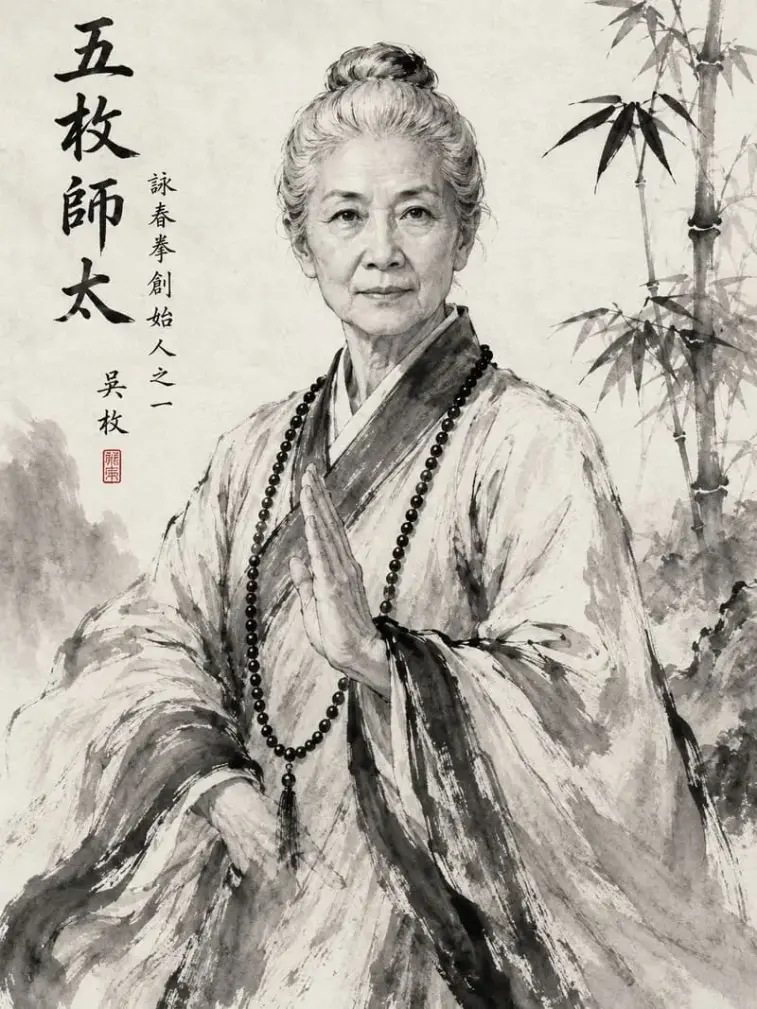
A story passed down orally
She is said to have watched the crane fight the snake.
From this, tradition says, Wing Chun was born.
Tradition tells that after the — legendary — destruction of the Southern Shaolin temple, a Buddhist nun named Ng Mui took refuge at the Mount Tai Leung monastery and spent years rethinking combat. The long, powerful boxing arts of the north suited neither her build nor the closeness of an alleyway.
The story, repeated by later generations, holds that she watched a duel between a white crane and a snake: the crane deflected without force, the snake struck straight, without winding up. Economy, line, sensitivity.
Never oppose force with force.
Become the shortest line.
From this observation, tradition says, a short and direct system was born, founded on the centre line, sensitivity of touch (聽勁, ting ging in Cantonese) and a relaxed skeletal structure — designed so that a smaller person could defeat a larger one.
The story that gives the art its name
A young woman refuses a forced marriage.
Tradition tells that in a village in Canton province, Yim Wing Chun (嚴詠春, "praise of spring") runs her father's tofu stall. A local warlord demands she marry him.
She agrees on one condition: that he first beat her in single combat. Ng Mui, met on the road to market, grants her six months of teaching. The young woman wins. The marriage never takes place.
The art now bears her name.
Yim Wing Chun later marries Leung Bok Chau, a salt merchant, to whom she passes on the system received from Ng Mui. He will give the style his wife's name: Wing Chun Kuen (詠春拳, "the boxing of the praise of spring").
From Leung Bok Chau to Leung Lan Kwai, then to Wong Wah Bo and Leung Yee Tai — performers of the Red Junk, a Cantonese opera troupe where the art stays hidden for a century —, transmission happens by word of mouth, at the margins.
The chain before Yip Man
Seven generations, two centuries,
a single transmission.
Before Yip Man, Wing Chun has almost no written record. It is knowledge passed hand to hand, in opera troupes and Foshan backyards. Seven masters, two centuries in the shadows — without them, nothing survives.
- c. 1700 Ng Mui Origin — Southern Shaolin
- c. 1720 Yim Wing Chun Gives the art its name
- c. 1740 Leung Bok Chau Husband — codifies the style
- c. 1780 Leung Lan Kwai Hidden transmission
- 1820 — 70 Wong Wah Bo · Leung Yee Tai Red Junk · Cantonese opera
- c. 1870 Leung Jan The "king of Wing Chun" · Foshan
- c. 1900 Chan Wah Shun Yip Man's master · Foshan
Yip Man, out of the shadows
A man brings Wing Chun out of the shadows and gives it to the world.
Born in Foshan in 1893 to a scholarly family, Yip Man (葉問) begins Wing Chun at age 7 with Chan Wah Shun. A police officer, then a refugee, he flees Foshan in 1949 and settles in Hong Kong, where he opens the first public Wing Chun school.
For the first time, the art is taught outside family transmission. Bruce Lee — his best-known student — is just one name among dozens of disciples who spread the art across the world: Wong Shun Leung, Leung Ting, Moy Yat... and William Cheung.
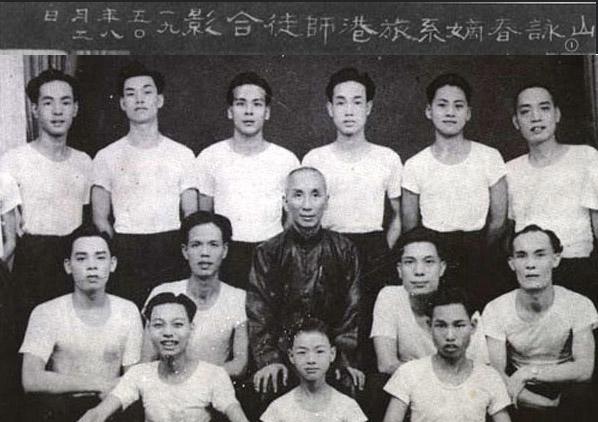
(school photograph / first students)
- 1949 — Hong Kong
- First public Wing Chun school. The art leaves the backyard.
- Direct students
- More than 60 certified disciples — including Bruce Lee, Wong Shun Leung, and William Cheung, founder of Traditional Wing Chun.
- Three forms
- Shil Lim Tao, Chum Kiu, Biu Jee — codified and passed on unchanged.
- 1972 — death
- At his death, Wing Chun is the most widely practised Chinese martial art in the world.
From the source to you
From Yip Man to Bordeaux,
in four handshakes.
The branch we pass on is that of Sifu William Cheung, a direct disciple of Yip Man and custodian of Traditional Wing Chun — the orthodox lineage.
In France, Sifu Didier Beddar has carried it forward from Paris. Josse Delaune and Damien Spieser, two former disciples, founded the WCTB school in Bordeaux Chartrons in 2016.
The chain · Yip Man to Bordeaux · 4 generations
- GENERATION 0 Yip Man
- GENERATION I Sifu William Cheung
- GENERATION II Sifu Didier Beddar Paris
- GENERATION III Sifu Josse Delaune Bordeaux
- GENERATION IV Today's practitioners You
A school is measured by the distance between its students and the source. With us, there are four hands between you and Yip Man.
Three centuries later,
the transmission continues.
Wing Chun exists only because, at each generation, someone agreed to pass it on — and someone agreed to receive it. In Bordeaux, the kwoon on Cours du Médoc is one of the links.